News
Bond Yields · Energy Prices · Geopolitics · Risk-Off
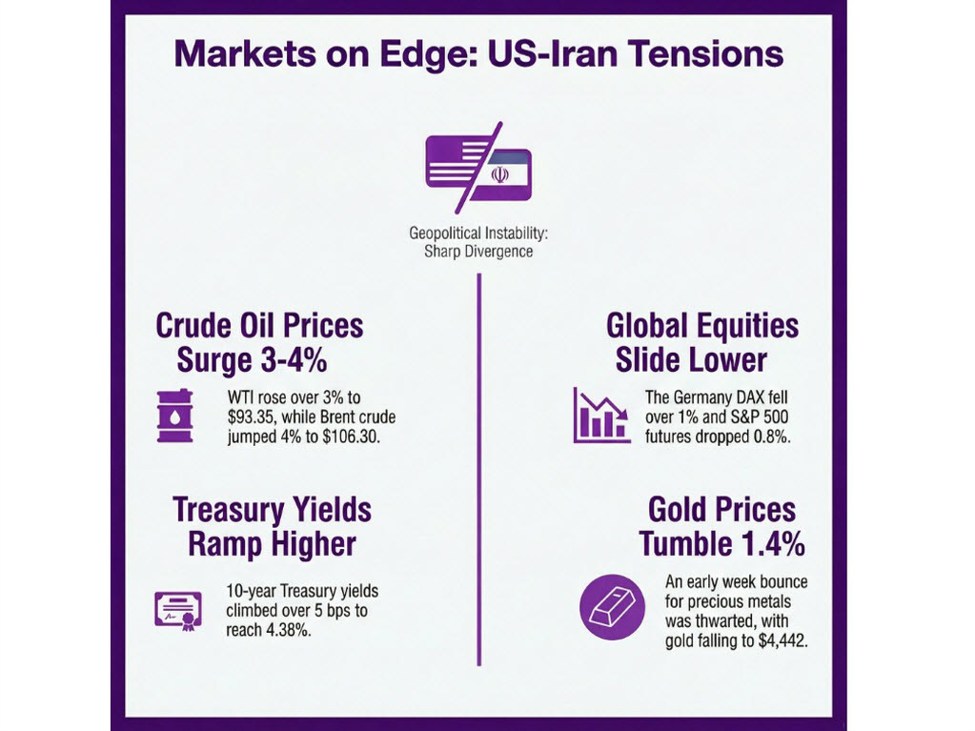
Global markets experienced a significant risk-off shift on March 23, 2026, as oil prices surged and U.S. Treasury yields jumped, while major stock indices across Asia and Europe tumbled by 1.5% to 6.5%, driven by escalating Middle East tensions and threats to energy supply.
This market reaction followed President Trump's warning to Iran regarding the Strait of Hormuz and Iran's retaliatory threats. Brent crude rose 1.5% to $113.88 a barrel, and WTI was up 3.5% to $98.06 a barrel.
European natural-gas prices surged 3.9% to 61.58 euros a megawatt-hour, up over 90% this month, due to Strait of Hormuz disruptions and severe damage to Qatar's LNG facility. U.S. equity futures for the Dow Jones Industrial Average, S&P 500, and Nasdaq were down 0.5%, 0.6%, and 0.7% respectively.
Asian markets saw sharp declines, with South Korea's Kospi closing 6.5% lower, Japan's Nikkei Stock Average down 3.5%, and China's Shanghai Composite falling 3.6%. European stocks also fell, with the Stoxx 600 down 1.7%, Germany's DAX sliding 1.9%, and the U.K.'s FTSE 100 and French CAC 40 both falling around 1.5%.
The dollar strengthened, with the DXY dollar index rising 0.2% to 99.812, benefiting from its safe-haven status and U.S. energy independence. U.S. 10-year Treasury yields rose to 4.423%, the highest since July 2025, and U.K. gilt yields hit levels not seen since 2008.
Precious metals, surprisingly, did not act as a safe haven; gold futures dropped 9.5% to $4,132.90 a troy ounce, silver fell 11.5%, and platinum was down 11%. Investors anticipate March PMI prints on Tuesday for insights into the conflict's economic impact.
Middle East Conflict Fuels Risk-Off, Global Stocks Tumble(current)
French Bond Yields Swing on Middle East Uncertainty