News
Global Markets · Oil Prices · Treasury Yields · War
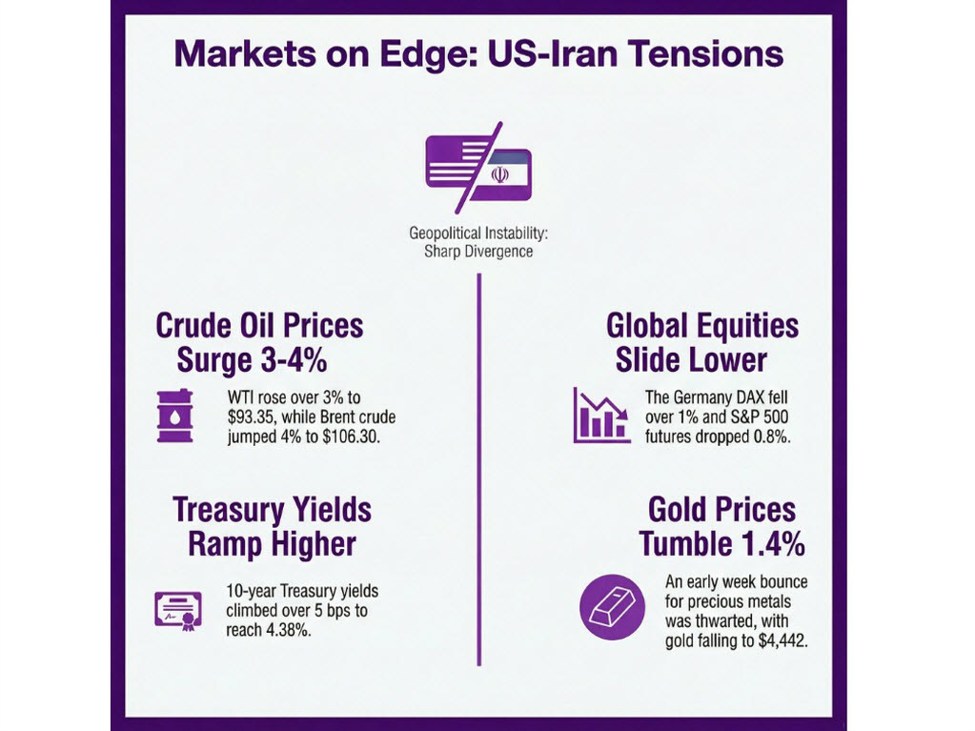
Global markets experienced volatility as U.S. Treasury yields rose and U.S. futures fell, driven by conflicting signals regarding a potential de-escalation in the Middle East conflict, with oil prices surging and precious metals declining.
President Trump's initial comments about "very good and productive conversations" with Iran, which buoyed markets, were subsequently denied by Iran, leading to renewed uncertainty. The Wall Street Journal reported U.S. allies in the Persian Gulf are nearing involvement in the conflict, contributing to an early rebound in oil prices.
Brent crude gained 1% to $100.98 a barrel, and WTI was up 2.9% to $87.85 a barrel, despite Goldman Sachs analysts noting a retreat in perceived risks. European natural-gas prices fell 1.6% to 55.78 euros a megawatt-hour, though ANZ analysts highlighted lasting supply impacts.
U.S. futures for the Dow Jones Industrial Average and S&P 500 slipped 0.2%, while Nasdaq futures were 0.1% lower. Asian equities, including Japan's Nikkei Stock Average (up 1.4%), South Korea's Kospi (up 2.7%), and Hong Kong's Hang Seng Index (up 2.4%), broadly rose on initial de-escalation hopes.
European stocks, however, were mostly lower, with the Stoxx 600 down 0.05%, and industrial and construction sectors lagging. The dollar strengthened 0.3% (DXY index to 99.231) as a safe haven, while gold prices were broadly flat but down nearly 12% on the week, with Saxo Bank analysts attributing sales to its liquidity.
U.S. Treasury yields rose, with the two-year yield up 6.8 basis points to 3.897% and the 10-year yield up 4.4 basis points to 4.379%, indicating investor concern about inflationary impacts over growth risks.
Global Markets Falter; War Hopes Dim, Oil Surges(current)
French Bond Yields Swing on Middle East Uncertainty